

☕ 12 min read
You can work with ServiceNow every day and still struggle to keep up with everything ServiceNow has been announcing around AI. The vocabulary has grown quickly: Otto, AI Agents, AI Control Tower, Moveworks, MCP servers, Veza, Armis, Autonomous Workforce, plus changes to ServiceNow’s AI product and consumption model and much more.
At Devhd, continuous learning is part of how we work with the platform, but delivery and research are different modes of work. As we started looking more closely at these changes, one thing became clear: these are not unrelated concepts to memorize. They are pieces of the same shift.
ServiceNow is increasingly positioning its AI Platform as a system where AI can understand intent, use enterprise context, take governed action across systems and complete more of the work behind a request.
The research prompted this series: not another exhaustive list of announcements, but a practical attempt to connect the dots for people who already know ServiceNow and have not had time to research every new piece in depth. This first article looks at the bigger picture.
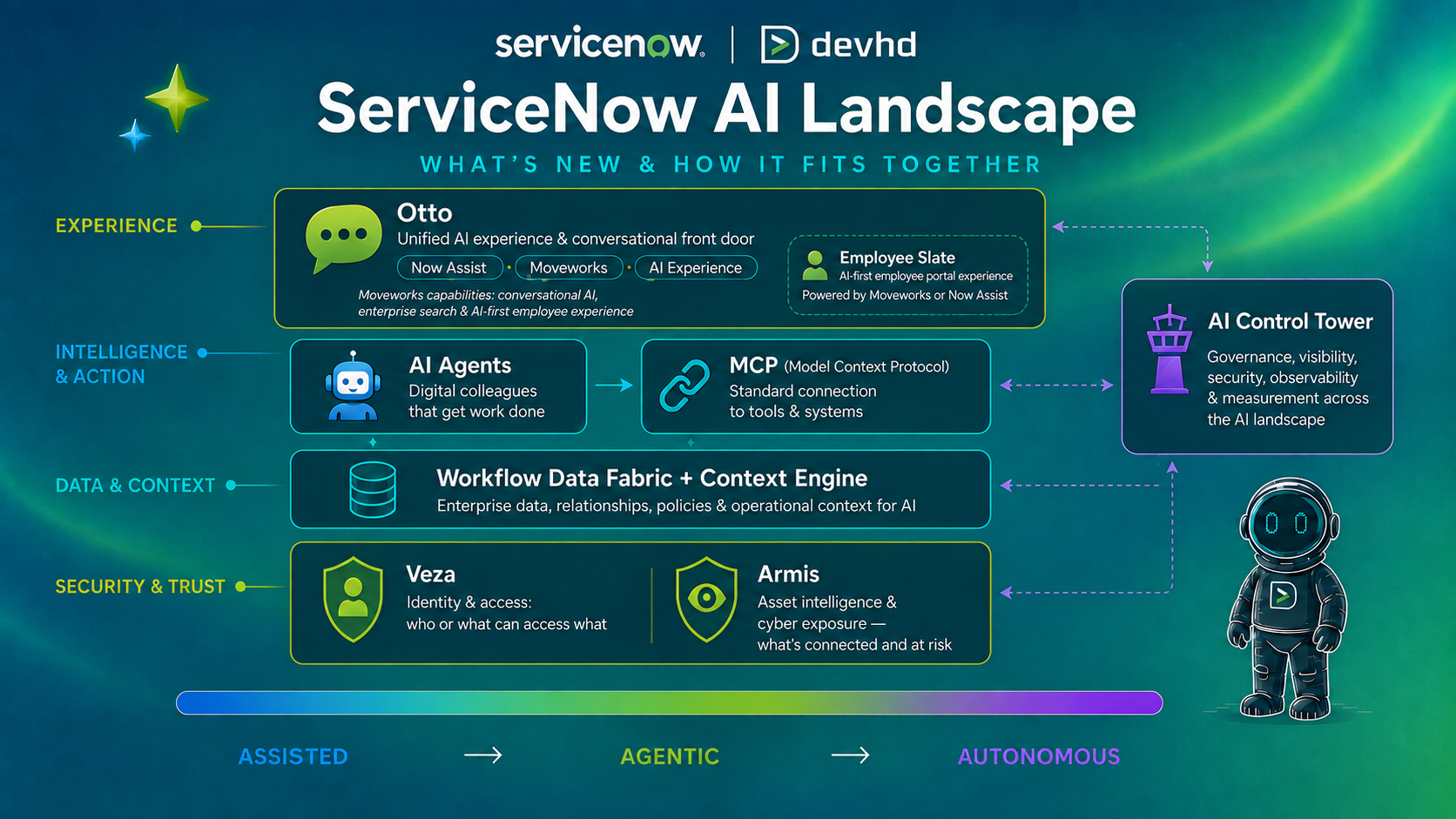
Here is a simple way to think about the pieces and how they fit together.
One simple analogy: think of the enterprise as a large building
In that building:
- ServiceNow Otto is the reception desk and unified AI interface you talk to.
- Employee Slate is the employee-facing place where that conversation happens (it can currently be powered by either Moveworks or Now Assist)
- Moveworks brings conversational AI and enterprise search capabilities that now help shape the experience brought together under Otto.
- AI Agents are the digital colleagues that can carry out tasks.
- MCP (Model Context Protocol) is a standard connection method that lets AI use tools and systems.
- Workflow Data Fabric is the data network running through the building.
- Context Engine is the building’s institutional memory and rulebook.
- AI Control Tower is the control room that sees and governs the AI landscape.
- Veza is the access guard that helps answer who or what is allowed to access what.
- Armis is the radar that helps discover connected assets and understand their cyber exposure.
- AI consumption adds usage-based measures such as Assists alongside product tiers and entitlements as AI executes more work.
ServiceNow Otto: the AI interface for getting work done
At the simplest level, ServiceNow Otto is the AI experience through which people can interact with ServiceNow in natural language. Instead of knowing which module, menu or workflow to open, a user can ask for what they need.
For example, an employee might say: “My laptop is locked. Help me fix it.” A support manager might ask: “Show me the critical incidents from the last 24 hours and tell me which ones appear to have the same underlying issue.”
Otto is designed to understand the request, bring in the relevant business context and route the work to the appropriate AI, workflow or system. ServiceNow describes Otto as the unified experience that brings together Now Assist, Moveworks and AI Experience.
Employee Slate: the AI-first employee portal experience
There is one more new term worth clarifying: what exactly is Employee Slate? Employee Slate is ServiceNow’s new AI-first employee portal experience. Instead of navigating a traditional portal to find the right page or form, employees can start with a conversation and use the same destination to search for information, submit requests, manage tasks and stay informed. The conversational experience can currently be powered by Moveworks or Now Assist, depending on the deployment.
Note: ServiceNow provides separate documentation for Employee Slate for Moveworks and Employee Slate for Now Assist. The Moveworks option is positioned as the richer experience and is recommended by ServiceNow, while Employee Slate can also run with Now Assist.
A simple way to separate the two: Otto is who you talk to; Employee Slate is the employee-facing place where that conversation can happen. And the important part is not simply that AI can answer. The direction is toward completing the work behind the request.
Moveworks: conversational AI and enterprise search
Moveworks became part of ServiceNow after the acquisition closed in December 2025. Before that, it was already well known for conversational AI, enterprise search and helping employees get answers or take action across workplace systems.
Think about the kinds of questions employees ask every day: “How many vacation days do I have?”, “I need access to an application”, “Where is the travel policy?” or “How do I reset my password?” Moveworks was built around making those interactions feel natural rather than forcing employees to know where the answer lives.
Within ServiceNow’s current direction, Moveworks is best understood as one of the capabilities now brought together under Otto, alongside Now Assist and AI Experience. Its strengths in conversational AI and enterprise search help shape the AI-first experience brought together under Otto.
AI Agents: from giving answers to doing work
This is one of the most important concepts in the new AI landscape.
A traditional assistant helps a person understand what to do. An AI Agent can be given a goal, gather context, reason within defined boundaries and execute actions that would otherwise require human work. In this context, agentic means AI can reason, choose from approved tools and take actions toward a goal rather than only generate an answer.
Imagine a P1 incident. An AI Agent could be designed to analyze the incident, use context such as related CIs and historical cases, consult knowledge, call approved tools, update records or trigger the next workflow step. Depending on the use case and governance model, a human can remain in the loop for approvals or higher-risk decisions.
In simple terms: a copilot helps you work; an AI Agent can perform part of the work. ServiceNow is taking this further with the idea of an Autonomous Workforce: AI specialists able to execute broader jobs and multi-step processes under defined scope, authority and governance. More about Autonomous Workforce in a future Devhd series.
MCP: the “USB-C” of AI connections
MCP stands for Model Context Protocol. You do not need to know the technical specification to understand why it matters.
An AI model may be very good at understanding language and reasoning, but enterprise work depends on data and actions that live in other systems. The AI needs a reliable way to discover what tools are available, access the right context and call those tools.
A useful analogy is USB-C: instead of inventing a different proprietary connection every time an AI needs to interact with a tool, MCP provides a common protocol for exposing tools and resources to AI applications.
The word "server" here does not mean you need to picture a physical machine. In practical terms, an MCP server is a software endpoint that exposes tools or resources to an AI client through the protocol. Think of it as a standardized gateway or adapter.
In ServiceNow, this becomes particularly important because the platform is not only a place where records live. Records are tied to business rules, approvals, workflows, SLAs and actions. ServiceNow Action Fabric is the layer that opens governed ServiceNow actions to ServiceNow and third-party AI agents through MCP, A2A and other supported protocols, using the platform’s existing workflows and guardrails. More about the technologies behind the new AI Platform in a future article.
That is why MCP is worth understanding even if you are not a developer. It is becoming part of the connective tissue of agentic AI.
Workflow Data Fabric and Context Engine: giving AI the right enterprise context
Connecting an AI agent to tools is only part of the story. It also needs the right enterprise data and context to make useful decisions.
Workflow Data Fabric connects ServiceNow to data across enterprise systems, while Context Engine adds the relationships, policies, history and operational context behind that data.
A simple way to remember the difference: Workflow Data Fabric brings the data into the picture; Context Engine helps AI understand what that data means in the context of the business.
AI Control Tower: governance for the AI estate
Once an enterprise starts using many agents, models, datasets, prompts and MCP servers, a new problem appears: who is keeping track of all of it?
That is the role of AI Control Tower. It gives organizations a central hub to discover AI assets, secure and govern AI activity, observe performance and measure value across first- and third-party AI.
The aviation analogy fits especially well here: AI Agents are the aircraft; AI Control Tower is the control tower. It does not fly the aircraft itself, but it needs visibility into what is operating, where it is going and whether it is operating within the rules.
ServiceNow includes MCP servers among the AI asset types AI Control Tower can discover and inventory, alongside agents, models and other AI assets. This matters because the more AI can act across systems, the more important visibility, approvals, auditability and least-privilege access become.
Veza: who or what can access what?
Veza adds an identity security perspective to the ServiceNow story. The core question is simple: who or what has access to which data, applications and systems?
In an AI-enabled enterprise, “who” no longer means only employees. It can also mean service accounts, applications and AI agents.
For example: should this AI Agent be able to read payroll data? Does this service account have permissions it no longer needs? Can we reduce access to the minimum required for the job?
This is the idea behind least privilege: every human or machine identity should have only the access it genuinely needs. ServiceNow completed the Veza acquisition in March 2026 to extend its visibility and control across access to applications, data, cloud environments and AI agents.
The easiest way to remember Veza is: who has access to what?
Armis: what is connected and what is at risk?
Armis answers a different security question. Instead of focusing primarily on identity and access, it focuses on connected assets and cyber exposure.
That includes familiar IT assets such as laptops and servers, but also operational technology, IoT devices, medical devices, cloud environments, code and other connected assets that can be difficult to see and manage consistently.
In a manufacturing environment, for example, an organization may have industrial devices connected to its network that traditional IT asset inventories do not fully understand. Armis can help discover those assets in real time, add context and prioritize cyber exposure and risk.
ServiceNow completed its acquisition of Armis in April 2026 and is combining that asset intelligence with ServiceNow workflows and governance.
A simple distinction is useful: Veza asks who has access to what. Armis asks what is connected and what is exposed to risk.
How the pieces can work together
Consider a simple scenario. An employee tells Otto: “My laptop is behaving strangely. Can you check it?”
Otto can interpret the request and orchestrate the appropriate workflow.
An AI Agent could investigate the issue.
MCP and other integrations can provide governed access to relevant tools and systems.
Armis could contribute cyber-asset and exposure context, while Veza could contribute identity and access context.
ServiceNow workflows can manage the incident, approvals and remediation steps, with AI Control Tower providing governance and visibility across the AI estate.
Not every real-world implementation will use every component in every request. The point is the architecture: conversation, intelligence, context, action, security and governance are increasingly being connected on the same platform.
What is changing in ServiceNow’s AI commercial model?
The technology is changing and the commercial model is changing with it.
There are two ideas worth separating: the new product tiers and the growing role of consumption-based AI usage.
One important change is structural: AI is no longer positioned simply as a separate add-on. ServiceNow’s new product tiers embed AI capabilities directly into product packaging, with increasing levels of agentic and autonomous functionality from Foundation to Advanced to Prime.
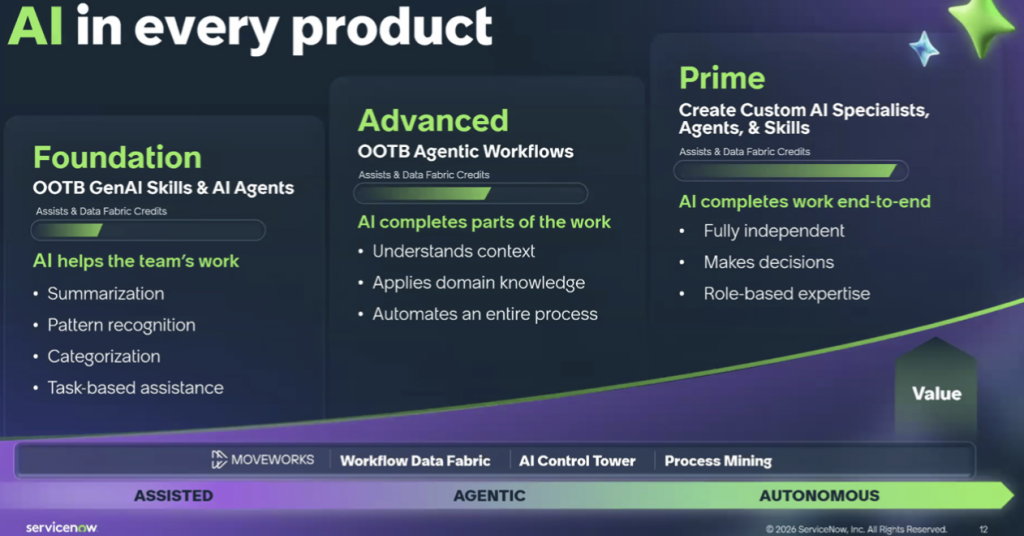
ServiceNow structures its current AI-native product packaging around three tiers: Foundation, Advanced and Prime. Each tier builds on the previous one with additional AI capabilities, agents and governance tools.
A simple mental model is:
- Foundation = AI assists the work.
- Advanced = AI can complete more of the work through agentic workflows.
- Prime = AI can support more autonomous, end-to-end execution.
This is the direction. Exact availability and entitlement details depend on the ServiceNow offering and customer agreement.
Why consumption matters more in an AI world
Traditional enterprise software licensing has often been easy to picture: a company has a number of users and it pays for the licenses those users need.
AI changes the equation. An AI Agent is not simply “employee number 1,001.” One agent may execute a small number of tasks, or thousands of actions across a process. The amount of work performed by the technology becomes an important part of the value equation.
This is why AI consumption is becoming more visible in the ServiceNow commercial model. Assists are ServiceNow consumption units for AI capabilities. For AI Agents, agentic Assist consumption is primarily determined by the number of tools executed in an agentic workflow rather than by raw LLM token counts.
Do we all know what an LLM token is by now? Maybe not. It came up in one of our conversations about AI consumption, so it is worth keeping a quick definition here for anyone who would appreciate the refresher.
Product tiers and entitlements remain part of the commercial structure, while some AI capabilities are also metered through Assists or other usage-based units. In practice, customers need to understand both what they are entitled to use and how metered AI usage is consumed.
Note: having AI capabilities included in a tier does not necessarily mean unlimited AI usage. Some AI usage is metered through Assists, while Workflow Data Fabric uses its own Data Fabric Credits.
For customers, this also means that architecture and governance have a commercial dimension. As AI usage scales, organizations need to understand not only what agents can do, but how often they run, how much value they create and how consumption is monitored.
The bigger picture: ServiceNow is becoming a system of action for AI
At Devhd, the more we looked at these pieces together, the clearer the bigger picture became: the individual product names matter, but the broader shift matters more.
ServiceNow is positioning AI as a platform-level capability, not only as individual features inside ITSM, CSM, HRSD or other workflows. The broader direction is to connect AI with enterprise data, context, workflows, approvals, identity, security and governance so that AI can move from answering questions to completing work.
That changes the role of the platform. The user does not always need to know which application or workflow sits behind a request. They can express an intent and the platform can orchestrate what needs to happen next.
For ServiceNow customers and partners, that makes three concepts especially worth understanding now: AI Agents, MCP and AI consumption. Once those three are clear, Otto, AI Control Tower, Veza, Armis and the rest of the ecosystem become much easier to place in context.
This is the first in a Devhd series on the newer pieces of the ServiceNow AI landscape. In follow-up articles, we will go deeper into subjects like: AI Control Tower, Moveworks, Veza, Armis, Autonomous Workforce and the new ServiceNow AI commercial model.
A quick reference
| Question | Think of |
| What do I talk to? | ServiceNow Otto |
| What is the employee-facing portal experience? | Employee Slate |
| What can power Employee Slate’s conversational experience? | Moveworks or Now Assist |
| What contributes conversational AI and enterprise search capabilities? | Moveworks |
| Who can perform the work? | AI Agents / Autonomous Workforce |
| How can AI connect to tools and governed actions? | MCP / Action Fabric / integrations |
| What can give AI the right enterprise context? | Workflow Data Fabric and Context Engine |
| Where is AI governed? | AI Control Tower |
| Who or what has access to what? | Veza |
| What assets are connected and exposed to cyber risk? | Armis |
| How is AI usage increasingly measured commercially? | Assists / consumption units alongside subscriptions |
* Article by Nicoleta Daniș, Marketing and Communication @ Devhd