Safety is more than a product—it's a promise.

As a major player in the automotive safety systems sector, our customer is driven by a mission to reduce traffic fatalities and serious injuries worldwide. This commitment extends far beyond the factory floor—it shapes everything from product innovation to IT operations. With a global workforce of over 60,000 and a presence across multiple regions, the company continues to advance life-saving technologies for the automotive industry.

But safeguarding lives today also means ensuring digital resilience. A few years ago, this company has partnered with Devhd, a boutique ServiceNow consultancy and implementation team, to automate IT processes, streamline complex integrations and enhance internal governance workflows—leveraging the ServiceNow platform as a strategic enabler of efficiency and control. This long-standing collaboration empowers global IT teams to focus on high-impact initiatives, turning automation into a catalyst for smarter innovation and safer outcomes.

The Challenge: Global Governance at Scale

The company’s IT landscape includes numerous internal applications, strict regulatory requirements (including SOX) and thousands of requests for access and configuration changes each month. These requests—ranging from firewall exceptions to SAP role changes—required time-consuming manual interventions and varying approval processes.

The challenge wasn’t just volume. It was consistency, auditability and the need for a standard, secure way to manage requests globally.

The Collaboration

To address this complexity, the customer engaged Devhd as a trusted partner. With deep Now Platform expertise and a pragmatic approach to process design, the team helped translate governance objectives into scalable digital workflows—built natively on the ServiceNow platform.

Over the years, this partnership has evolved from early platform implementations to a focused automation strategy—centered on governance, visibility and control—that now supports key IT operations and internal compliance workflows across the company’s global landscape.

Building a Strong IT Foundation: ITSM & CMDB Maturity

To ensure automation and governance could scale effectively, the first focus was strengthening core IT operations. This meant refining ITSM workflows and establishing a structured, reliable CMDB, which served as the foundation for more advanced digital governance capabilities.

The company initially adopted ServiceNow ITSM and later upgraded to ITSM Pro to further enhance performance and agility. The move unlocked advanced capabilities such as predictive intelligence, DevOps automation, performance analytics and dynamic translations—tools that improved IT visibility, accelerated incident resolution and supported more proactive, data-driven decision-making.

Alongside this transition, Devhd supported the development of a healthy CMDB, integrating systems like SCCM & Intune to compare, reconcile and maintain up-to-date configuration data. By ensuring a single source of truth, the customer strengthened its ability to manage IT assets, track dependencies and optimize service delivery—laying the foundation for scalable automation.

Enhancing Employee Experience Through Self-Service & Process Automation

As part of a broader automation initiative, a user-friendly, unified Employee Center was introduced, helping with incident deflection, allowing agents to prioritize and address other problems more important to the organization. Users benefit from guided procedures and relevant results even before submitting a ticket. The successful transition to a self-service model exemplifies the effectiveness of this simplified, user-driven approach.

In addition, the portal serves as a centralized IT service catalog, supporting:

  • User request automation, ensuring structured submissions and tracking.
  • Approval workflows, allowing managers to quickly review and authorize requests.
  • Bulk multi-approvals, simplifying complex request management across teams.

By consolidating IT services into a single interface, the organization has streamlined internal workflows, reducing manual intervention and improving overall service efficiency.

AGR – A Model for Repeatable, Compliant Automation

With the CMDB and ITSM maturity in place, the next step in the automation strategy was the Automated Governance Request (AGR) model — a custom-built account governance module within ServiceNow, co-developed by Devhd and the customer. Designed to streamline access provisioning, account maintenance and governance controls, AGR introduced:

  • Predefined governance settings to enforce standard access policies.
  • Standard request templates for a structured, repeatable approach to access management.
  • Automated workflows, which handle account lifecycle processes across multiple integrated systems. 

Integrations within AGR: automating Account Governance across systems

With AGR fully implemented as the organization’s custom account governance module, Devhd collaborated with internal teams to build seamless integrations with multiple enterprise systems, ensuring that account provisioning, access management and approvals could be processed automatically rather than manually.

Each integration was structured within AGR to:

  • Standardize user role requests using predefined tables and governance rules.
  • Automate account lifecycle management, from creation to access maintenance and termination.
  • Eliminate manual intervention, significantly reducing administrative workload while ensuring compliance.

Key Integrated Systems & their impact:

  • AFIS – Automated role assignments based on predefined policies, streamlining cost-related approval workflows.
  • ICAN – Processed over 10,000 requests, simplifying access provisioning across critical applications.
  • COUPA – Consolidated access management based on role and location, processing 5,000+ requests efficiently.
  • Blackline – Automated finance tool operations, optimizing reconciliation workflows.
  • Movex – Enabled 24,000 automated requests, integrating access governance into production-line management.
    • Reconciliation automation: Every three months, AGR compares ServiceNow access data with Movex records and triggers reconciliation tasks for discrepancies, ensuring high governance accuracy.
  • Rapid7 – Strengthened security automation, reducing manual IT involvement in access provisioning.

Measured Success: The Broader Impact of Automation with ServiceNow

From core ITSM modernization to intelligent access governance with AGR, this automation journey has led to measurable operational gains across the board. Together with Devhd, the customer has transformed critical IT processes— reducing hands-on effort, strengthening compliance and speeding up service delivery across global operations.

Highlights include:

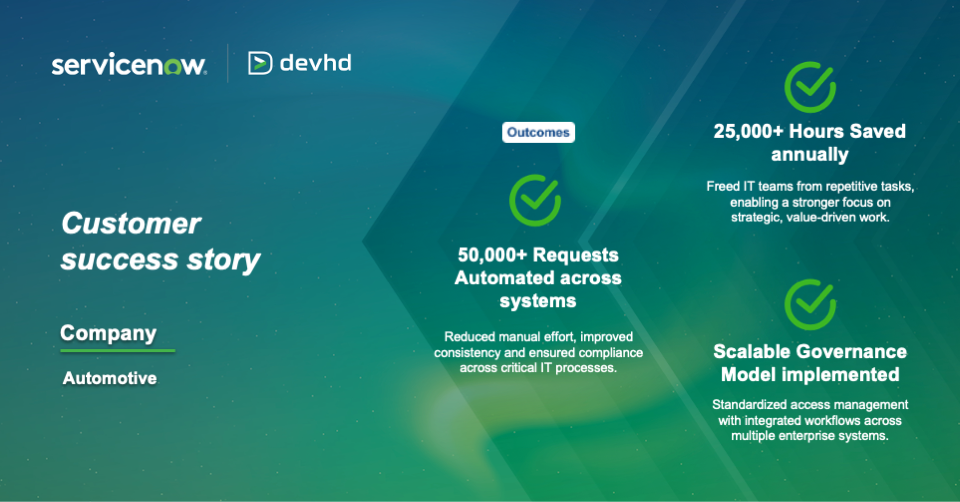
50,000+ automated requests processed across systems, eliminating manual approvals & data entry.

25,000+ hours saved annually, freeing IT teams to focus on strategic, high-value work.

Reduced operational overhead and faster service delivery, improved visibility and more consistent governance across 27 countries.

The organization has successfully transformed governance processes, improving visibility, standardization and operational efficiency across its global IT landscape.

As the automation journey continues, the long-standing partnership with Devhd highlights the value of consistent collaboration built on trust, technical depth and shared purpose. From initial implementation to platform design and strategic consulting, Devhd has supported the customer in shaping scalable workflows on ServiceNow. Throughout this journey, Devhd’s experienced architects have worked closely with internal teams to align governance objectives with platform capabilities—laying a strong foundation for long-term efficiency, compliance and innovation.

From the very beginning of our partnership, exccon AG and Devhd discovered how naturally we complement each other — forming unified delivery teams that combine agile thinking, specialized expertise and boutique-level quality from end to end.

One of our most impactful collaborations is the ServiceNow Workplace Service Delivery (WSD) implementation for a leading global company — a long-standing exccon customer with a clear vision to digitize and simplify all workplace and facility management processes across their organization.

The Challenge

The client, operating multiple sites with over 40,000 employees, already relied on several ServiceNow solutions to streamline IT and business operations.

The next step was to extend that maturity to the physical workplace — connecting people, spaces and services through the same intelligent platform and to move beyond manual, fragmented processes for managing facilities, reservations and workplace requests.

Previously, issues were reported via email, handled manually by external providers and tracked in spreadsheets. The lack of structure, data visibility and automation created inefficiencies across teams. In addition, meeting room reservations, catering requests, event management, and visitor management were supported by a bespoke legacy solution that had reached the end of its technological lifecycle and required modernization.

How do you extend a mature ServiceNow ecosystem to include the physical workplace experience?

How can employees, facility teams and service providers collaborate in real time — across locations, resources and systems — through a single platform?

These were the questions that guided and shaped the Workplace Service Delivery solution — transforming workplace operations into a connected, data-driven experience.

The Solution — Workplace Service Delivery on ServiceNow

exccon and Devhd jointly implemented the Workplace Service Delivery solution — designed to fit seamlessly into the client’s existing ServiceNow ecosystem — and continue to strengthen the platform architecture while expanding it with new modules.

The first go-live for Case Management ran smoothly, supported by close collaboration and a shared ServiceNow delivery mindset across both teams.

The result is a strong foundation that continues to evolve, featuring:

  • A self-service portal integrated into the Employee Center for easy access to workplace and building services;
  • Structured request & defect handling ensuring clean, standardized data;
  • Dashboards and reports for real-time transparency in building operations;
  • Automated integration with external facility management systems;
  • And a focus on user experience, encouraging adoption from day one.

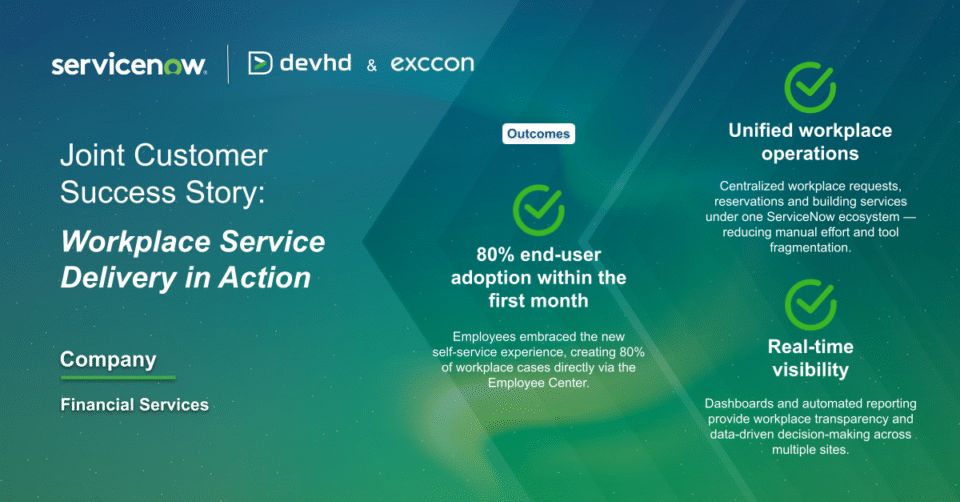
The platform has already proven its success, achieving an 80% end-user adoption rate for case creation via the Employee Center within the first month of the WSD Case Management go-live. The team is now extending it with Visitor Management, Reservation Management, Indoor Mapping, Event Management and several other modules planned throughout 2025.

Teamwork that makes the difference

The exccon–Devhd team brings together strategic insight, delivery excellence and deep platform expertise — ensuring that every challenge is approached from multiple angles, with the customer always at the center.

Together, we deliver across the full spectrum of project needs — from integration design and data quality to architecture and WSD consulting — proving that real value emerges when diverse skills work as one.

Voices from the team

“I joined the project after the first phase of WSD was already live and I immediately understood how naturally the collaboration worked. The client and exccon team were open, aligned and detail-oriented — it made it easy to integrate and contribute from day one.

My advice for future WSD customers is simple: focus early on data quality, which is the foundation of what we build. WSD is powerful, but clean and structured data is key to making it shine.”

Florin Danis, ServiceNow Architect, Devhd

“Working with Devhd feels like an extension of our own team. We share the same mindset — listen carefully, challenge thoughtfully and deliver with precision. Together, we provide process expertise, technical excellence, and a positive team spirit to every project.

We’ve created a solution that not only meets the customer’s goals, but sets a strong foundation for their future, global workplace strategy.”

Christiane Brzezek-Korupp, Project Manager, exccon


Advice from the technical team — What future WSD customers should know

1️⃣ Start with clean, reliable data.

Workplace Service Delivery depends on accurate information about data location (regions, sites, campuses, buildings, floor, spaces, rooms). If those records aren’t structured properly, processes won’t flow smoothly. Integrate early with the system that holds this data — ServiceNow doesn’t have to be the source of truth, but it should connect to it.

2️⃣ Think integration-first.

For example, connecting Microsoft Exchange with WSD Reservationsensures employees see real-time reservation details directly in Outlook — a small detail that makes a big difference in adoption.

3️⃣ Keep structure and communication strong.

WSD covers many data layers and process flows; ongoing collaboration between the technical team and customer stakeholders is key to building a sustainable, intuitive solution.


Looking ahead

This project demonstrates what’s possible when two boutique ServiceNow partners combine their strengths — turning complex workplace operations into connected, data-driven experiences.

Together, exccon and Devhd have built a foundation for continuous innovation, helping organizations maximize the potential of their Now Platform and reimagine how workplace services are delivered: simpler, smarter and more connected than ever.

Looking to explore Workplace Service Delivery (WSD) for your organization?
Contact our joint ServiceNow team at Devhd & exccon — we’ll be happy to discuss how WSD can simplify your workplace operations.


*  Article by Nicoleta Daniș, Marketing and Communication @ Devhd

Overview and Challenge

As a spin-off of Autoliv, Veoneer is a leader in automotive safety systems, developing both software and hardware for state-of-the-art Restraint Control Systems. Serving some of the largest car manufacturers globally, the company employs around 2700 people across 11 countries. As it continues to scale, Veoneer faces challenges in managing IT operations, ensuring compliance, and enhancing employee experience.

Initially, Veoneer utilized ServiceNow for Asset and Incident Management. However, their previous setup was fragmented, relying heavily on manual processes, including emails and spreadsheets. They needed a comprehensive, automated system to manage IT requests, incidents, and compliance and a user-friendly portal for employees.

A Platform for Growth with the Right Partner

To meet these demands, Veoneer sought a trusted partner capable of delivering end-to-end ServiceNow solutions. Devhd was selected for our deep expertise, agility, proven track record in driving automation and established relationship with Autoliv, Veoneer’s parent company, dating back to 2016.

As a relatively young company, Veoneer also needed to build critical infrastructure, such as Active Directory and an Employee Center, from scratch while streamlining processes with custom applications.

The Solution: Streamlining IT Services and Governance

Devhd focused on creating a solid ITSM foundation, ensuring Veoneer’s platform was optimized for automation and future scalability. Key initiatives included:

  • Active Directory & Employee Center Integration: Providing centralized user management from scratch.
  • Custom ITSM Portal: A branded, user-friendly portal allowing employees to easily request IT services. Customizations included approval lists and ticketing systems for improved efficiency.
  • Virtual Agent & Teams Integration: Streamlining communication and task automation.
  • Systems Integration: Ensuring that Veoneer’s ServiceNow instance communicates seamlessly with various critical systems, enabling automation and reducing manual efforts across IT services.

Integrations included:

o GitLab and SecOps Solutions: Automating ticket creation and updates, significantly reducing manual input from developers.

o Service Graph Connector for SCCM: Bringing in data from Microsoft’s System Center Configuration Manager (SCCM) to enhance asset and configuration management.

o SolarWinds Integration: Streamlining monitoring and incident response by integrating SolarWinds data into ServiceNow.

o Jira Integration: Enabling bi-directional updates between ServiceNow and Jira, reducing time spent on managing tickets across platforms.

o REST Integrations with Various Systems: Implemented REST APIs to connect ServiceNow with multiple third-party applications, enhancing automation and ensuring real-time data exchange.

Leveraging ServiceNow’s Workflow & Integration Hub

One of the most impactful transformations was the automation of 70% of IT service requests using ServiceNow's Workflow and Integration Hub. Key automation examples included:

  • Active Directory Integration: Real-time user account creation, updates, and deactivation.
  • Automating Access Management: Managing access to shared folders and specialized accounts (e.g., SFTP, VPN).
  • Optimizing HR Processes: Real-time updates from HR are reflected in Active Directory, eliminating delays and manual errors.

A critical enabler of this automation was a custom solution developed by Devhd, which included two default workflows—one for approval and one for fulfillment. These workflows enabled Veoneer to rapidly configure new catalog items, significantly reducing the time required for creation and fulfillment. The simplicity of the configuration is key, as administrators need only to complete data within specialized sections of each catalog item form to set up approvals, integrations, fulfillment, and notifications. This approach provides enhanced visibility over the entire process, while the customization via scripting allows for both straightforward and complex logic, tailoring the system to Veoneer’s specific needs.

Another important challenge for Veoneer was the labor-intensive nature of manual onboarding and offboarding processes. HR personnel had to input data across multiple systems, which often led to delays and potential security risks due to slow account deactivation. To solve this, Devhd designed a global application that fully automates these processes. By linking their HRM system to Active Directory we ensured real-time data synchronization, which reduced manual errors, enhanced security by promptly deactivating user accounts, and drastically cut down the time and effort required.

Ensuring a Healthy and Trustworthy CMDB

A reliable CMDB was essential for supporting Veoneer’s IT operations. Devhd utilized the Common Service Data Model (CSDM) framework to implement and structure the CMDB effectively. The team integrated configuration items (CIs) from multiple sources, including systems like SCCM, SolarWinds, Puppet, and Microsoft Intune. By using automated connectors (e.g., Service Graph Connectors) and import sets, we streamlined the CI population process and minimized duplication risks. The system was designed to reconcile CI attributes in real-time, ensuring a healthy and trustworthy CMDB that provides accurate, up-to-date information across all IT services.

This improvement significantly boosted the integrity of Veoneer's configuration management, while maintaining consistency and reliability in the data. Automating CMDB population under the CSDM framework also enhanced asset management and operational consistency across the enterprise.

With this solid foundation, Veoneer’s team is better equipped to manage configurations, track assets, and resolve IT issues, all while benefiting from a system that continuously reflects the true state of its infrastructure.

“We focused on ensuring that configuration items (CIs) were accurately identified and managed throughout their lifecycle, maintaining integrity, and securing the relationships necessary for controlling our services. With ServiceNow, we could automate processes and align our CMDB structure with key business needs, supporting our commitment to operational excellence, security, and compliance,” says Natalia Klaus, ServiceNow Platform Owner at Veoneer.

Automating Governance with AGR and SOX Compliance

Operating under Sarbanes-Oxley (SOX) regulations, Veoneer required rigorous access controls. Initially, they struggled with a heavily customized SOX application that complicated changes and compliance management.

Devhd developed a comprehensive Account Governance and Re-approval (AGR) solution that automates controls around SOX applications. This dynamic re-approval app ensures continuous evaluation and revalidation of access, ensuring compliance and simplifying management.

Account Governance and Re-approval (AGR) Solution

Enhancing Real-Time Monitoring with AuditUP

Veoneer also faced challenges tracking unauthorized changes within SOX-relevant data fields. A key addition to Veoneer’s ecosystem was AuditUP, a custom application developed by Devhd (available on the ServiceNow Store) to ensure platform-wide governance and compliance.

AuditUP provides real-time monitoring of user activities, tracking changes across tables, fields, and configurations. Unauthorized changes would trigger alerts, creating an event that was then logged and processed. This solution reduced the manual workload required for monthly and annual SOX audits and required for monthly and annual SOX audits but also ensured full visibility into platform activities.

Benefits of AuditUP:

  • Instant detection of unauthorized events, improving compliance.
  • Enhanced visibility into platform administration activities.
  • Reduced manual work for SOX audits and monthly controls.
  • A fast, easy-to-implement solution with global enterprise usage.

Continuous Improvement

Devhd has empowered Veoneer to continuously enhance its IT operations by driving automation, strengthening governance, and optimizing IT service management processes. Through custom workflows, seamless integrations, and automated request management, Veoneer now automates 70% of IT requests, significantly reducing manual efforts. Real-time compliance solutions, including AuditUP for SOX governance and a healthy CMDB, provide greater visibility and accuracy across the enterprise. These improvements enable Veoneer to focus on innovation and strategic growth, supported by a foundation for ongoing enhancement.

We're thankful for Veoneer’s ongoing trust in our team over the years.

“Partnering with Devhd has been key in ensuring our IT processes are both efficient and compliant with SOX regulations,” says Natalia Klaus, ServiceNow Platform Owner at Veoneer. “With solutions like AuditUP, we’ve been able to keep everything aligned while strengthening our security framework. This collaboration has given us the tools to maintain control and visibility over our ServiceNow platform, and we take great pride in how we’ve successfully scaled our operations while maintaining high standards of compliance and security”.

At Devhd, our customers' successes are the best measure of our impact.

This story highlights how we helped a leading provider of IT and business services that offers a comprehensive portfolio, including consulting, system integration, and IT outsourcing, tailored to meet clients' unique needs across various industries. Recognized for its strong market presence and customer-centric approach, the company delivers innovative solutions spanning Cybersecurity, Cloud and IT Infrastructure, Applications, Data Center Services, and Business Consulting.

Understanding the Pain Points, Challenges, and Objectives

The customer initially faced challenges due to extensive customizations in their legacy ServiceNow instance and difficulties in achieving data segregation between their operational companies (OpCos) and external clients. Their primary objective was to deliver a consistent, secure global service experience to multinational clients.

To address these issues, Devhd and ServiceNow collaborated closely to assess the organization’s needs, ultimately identifying the ServiceNow Customer Service Management (CSM) module as a more suitable solution within their context (they had previously been using the SecOps module). This strategic shift aimed to prioritize customer experience and service excellence.

Why ServiceNow and Devhd?

The customer was already using ServiceNow when they approached us at Devhd, recognizing the platform’s potential to streamline complex service operations. ServiceNow’s versatility and robust capabilities made it an ideal choice for standardizing processes, enhancing data security, and supporting global service delivery.

Devhd provided guidance on the ServiceNow CSM module, which was a better fit for the customer's specific challenges. The close collaboration between Devhd, ServiceNow, and the customer was crucial in aligning the solution with their operational needs while improving service delivery. With over 10 years of successful ServiceNow projects, Devhd brought it’s team expertise to the table, to enable a smooth and impactful implementation.

The Implementation

Their Cybersecurity Department collaborated with us at Devhd to define and implement the ServiceNow CSM solution, including a Global Customer Service Portal. The project aimed to facilitate global service delivery to multinational clients by leveraging common tools and processes. Integrations with critical systems like Swimlane, Opsgenie, and Entuity enabled seamless information exchange, automated workflows, and real-time monitoring, ensuring that customer requests were promptly addressed and resolved.

This solution aligned well with their objectives, streamlining global service delivery and enhancing data security, significantly boosting their ability to provide reliable, high-quality service worldwide.

Phased Implementation

The phased approach broke the project into manageable stages:

1.     Phase 1: Proof of Concept (POC)

This phase involved configuring the ServiceNow CSM module to meet specific needs, including data segregation capabilities, and designing a scalable, flexible Global Customer Service Portal. Integration with Swimlane, Opsgenie, and Entuity ensured cohesive operations and real-time data flow.

2.     Phase 2: Standardized Processes

After the POC’s success, the second phase focused on implementing standardized processes for delivering cybersecurity and non-cybersecurity services globally. Data segregation solutions were enhanced to ensure only designated support groups within a customer account could access related cases.

Results

By centralizing its cybersecurity service operations on the ServiceNow platform with CSM, the organization achieved greater agility, transparency, and consistency. Operational companies now serve multinational clients more efficiently. Additionally, the Global Customer Service Portal offers a centralized, intuitive platform for customers to access relevant information and self-service solutions, significantly improving the user experience.

Future Enhancements and Strategic Growth with ServiceNow

The company plans to further leverage ServiceNow’s capabilities by expanding automation features to enhance operational efficiency, utilizing advanced analytics and AI-driven insights to better understand service trends and customer needs, and continuously adding new features to the customer service portal to improve user experience and service delivery. We look forward to building on this foundation for future opportunities to drive innovation and deliver value.


A dynamic organization specializing in mission-critical IT services and digital solutions for clients across industries such as banking, telecommunications, retail, and more, sought to enhance its operations and streamline IT processes globally. With a workforce of over 12,000 employees across multiple countries, the company needed a solution to improve internal efficiency, drive better service delivery, and ensure business continuity.

A platform for growth and the right partner

In 2020, this organization selected ServiceNow to provide an IT platform to optimize and integrate current and future IT Service Management processes. The company partnered with us at Devhd for implementation and ongoing support, working as a joint team to address its internal ServiceNow needs. The first step was defining a Service Portfolio to enhance visibility into business services impacted by IT processes and then configuring the ITSM module, from “house to home”, to fit their specific needs.

One of the key benefits was transitioning from multiple systems to a unified platform, allowing IT to better manage a complex global environment while reducing cycle times for changes and enhancements. Now, the business can appreciate the role of IT in supporting teams to perform and thrive, and how vital IT data and insights can be used to improve service delivery, promote efficiencies, and ensure business continuity.

A user-friendly self-service portal was introduced, helping with incident deflection, and allowing agents to prioritize and address other problems more important to the organization. Users benefit from guided procedures and relevant results even before submitting a ticket. The successful transition to a self-service model exemplifies the effectiveness of this simplified, user-driven approach.

From IT Services to a platform that keeps growing

A suite of ServiceNow products has played an important role in breaking down organizational silos and fostering continuous growth, with new capabilities developing each year. What started within IT services is now a platform that keeps growing.

The platform now connects various services within the company, such as IT Service Management, Hardware Asset Management, and Configuration Management Database. The platform's success is further exemplified by a custom global application developed by Devhd that automates the user onboarding and offboarding processes, reducing errors and non-conformities between ServiceNow, Oracle, and any sub-systems related to the process for their employee lifecycle, to less than 1%. Another example is a compact and user-friendly interface, enriched with custom catalog items and flows, optimizing procurement-to-pay activities. Additionally, it includes robust reporting and analytics capabilities that offer invaluable insights into operations. Leveraging real-time data and performance metrics empowers the company to identify bottlenecks, optimize processes, and make informed, data-driven decisions for continuous improvement. The platform’s reach extends further through numerous integrations with existing systems and custom applications, all contributing to this holistic strategy.

Easy-to-use, single system of record for IT infrastructure and digital service data

After implementing IT Service Management (ITSM), the joint team turned its focus to prioritizing operational configuration data. The initial step involved the development of a comprehensive Configuration Management strategy and plan. This effort resulted in the creation of a real-time, automated, and accurate Configuration Management Database (CMDB) tailored to the organization's specific needs.

The organization now confidently maintains a standardized, single system of records, extendable CMDB, housing precise and reliable data. Noteworthy features include daily automated updates, the adoption of the identification and reconciliation engine (IRE), robust control and governance mechanisms, health dashboards providing at-a-glance insights, and a dependency view for a thorough understanding of interconnections within the infrastructure.

Gaining a way of monitoring and maintaining the overall health of the CMDB, the company has access to quality metrics based on defined flexible criteria (detect duplicate, orphan, stale CIs) and a central place for working with the configuration data, to search and explore the CMDB, examine recent activity and provide health metrics for configuration items (Cis).

Shift to a lifecycle-driven asset management environment

The next step on the roadmap was the implementation of the Hardware Asset Management Pro solution, which introduced enhanced asset management capabilities and helped the organization gain full visibility across the hardware asset estate.

Leveraging the ServiceNow procurement application, Devhd has modernized the procurement request system of the customer, replacing the traditional method of submitting requests via email. All procurement requests now take place within the ServiceNow platform. When there is a need to purchase hardware, the process starts in ServiceNow, providing better traceability. This enhancement allows for efficient oversight of the entire lifecycle of assets—from the initial need, through the procurement process, to device registration in the stockroom, ongoing monitoring, and eventual disposal. Transforming their approach improved asset tracking, refined allocation and retrieval processes, elevated audit capabilities for compliance and accountability, and led to cost reductions.

Furthermore, data migration and standardization from the legacy system were successfully achieved, employing ServiceNow Hardware Normalization.

Additionally, the company empowered employees by providing them with the capability to manage and request hardware devices for their day-to-day activities through a unified dashboard portal. This facilitated access to the users' inventory and actions based on device state, lifecycle, stockroom availability, and user persona, with optimized flows.

This shift has positioned IT as a contributor rather than a business cost. With Devhd’s support and ServiceNow’s capabilities, IT now delivers actionable business intelligence to guide investment decisions, simplifies its asset base, and, by reducing incident volume, frees up time for IT professionals to focus on solving critical problems and creating innovative solutions.